Silent night

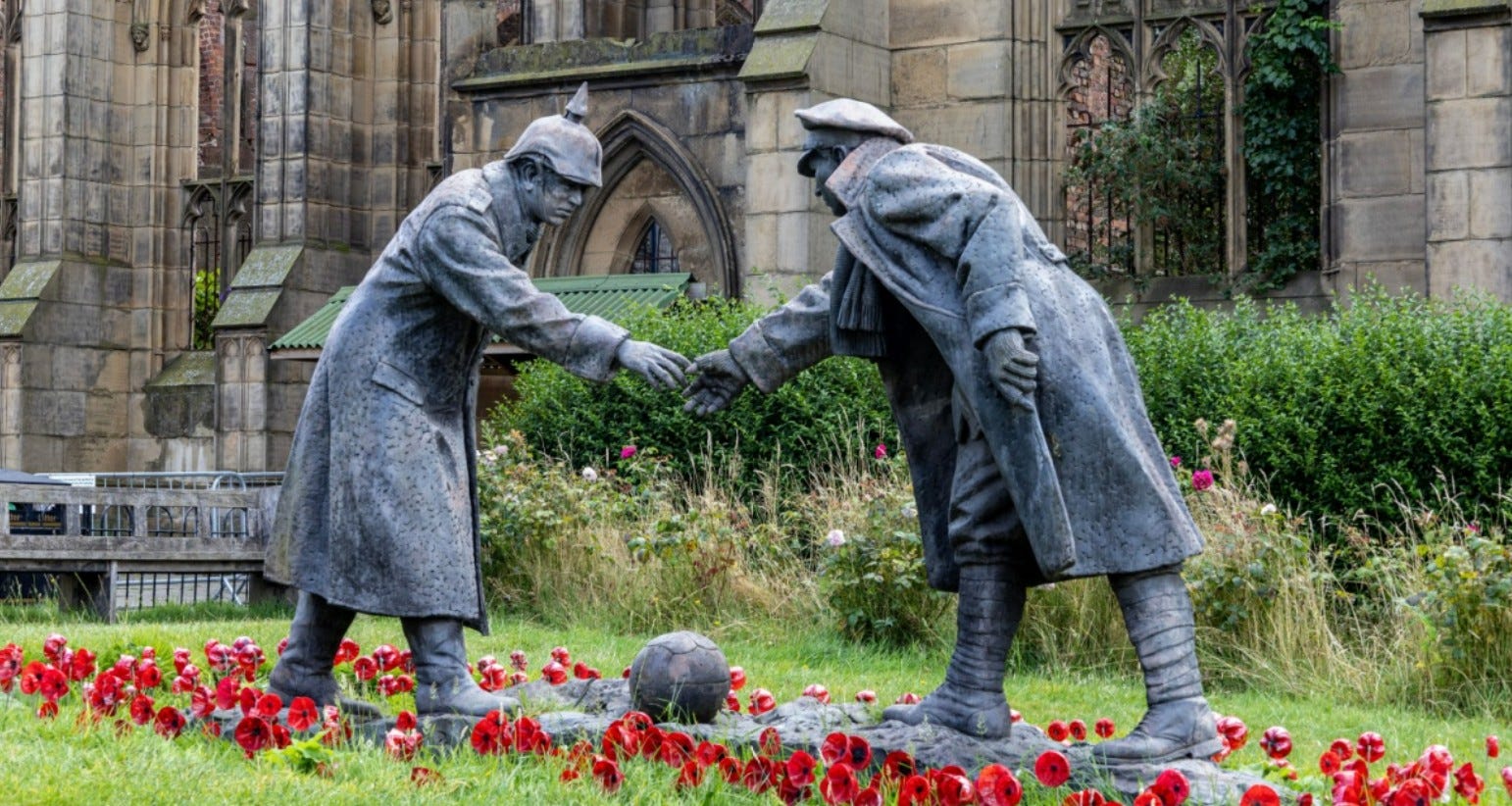
There are statues commemorating this night in England, France and Belgium
It was December 24, 1914, on the battlefields in Ypres, Belgium during the First World War, British, French and German soldiers had been mired in trench warfare for the past six months. It was wet, it was cold, the soldiers were wounded; they were hungry; they were freezing. They were in the middle of one of the most brutal and deadly wars that man had ever known. As they were pinned down, their dead comrades were lying in the No Man’s Land between the opposing trenches. The enemy combatants were so close they could almost see each other; they could hear each other talk and cough and writhe in pain. As the night crept in, despair crept over both groups of soldiers. Christmas was as far away as their homes. This was their Christmas. The mud and the blood of those trenches.
And then, spontaneously, on that clear starlit night in the midst of war, a General in the German army, who used to be an opera singer for the Berlin Opera, stood up, and began singing “Silent Night” in German. The British and French soldiers didn’t know the words, but they recognized the tune. A silence fell over the battlefield. All they could hear in the crisp cold air was that one soldier’s voice singing a song that was written a hundred years before in Austria to commemorate the birth of our savior. And then the other German officers, stood and joined in. They sang it once in German, and then they began to sing it in English. And when they sang it in English, the British soldiers, young and alone, away from home on Christmas Eve, stood up and began to sing along with them.
The French soldiers then began singing carols. And when they stood to sing, out of the trench and exposed, none of them feared for their lives. It was as if they were cloaked in the peace of Christ. The enemy soldiers climbed out of the trenches and met in No Man’s Land, shaking hands, sharing food and cigarettes, telling stories. They buried fallen comrades and played impromptu soccer games. They found common ground despite being told they were enemies. Candles were lit in the trenches and hung on trees, creating makeshift Christmas trees in the middle of war. And then suddenly, on this distance battlefield, a place mired with death and war, there was peace on Earth. The commonality of their shared humanity and their Christianity brought these warring parties to peace.
There are many layers to this story. Who were these soldiers’ real enemies? Were their enemies the other 18 and 19-year-old kids wearing different uniforms who were forced to be in those trenches that night rather than in their homes sharing Christmas with their families, or were their enemies the older men who forced them to be there? To paraphrase the famous quote about war, ‘War is where young men who don’t know each other kill each other, at the order of old people who do know each other, but don’t want to kill each other.’ And we saw with this spontaneous truce, these soldiers did not hate each other, did not really want to kill each other.
But this story goes deeper than that. It shows us the power of Christianity. In the midst of war, Christianity brings peace; Christ brings peace. When we allow the world to control our lives, we will become mired in war, either a hot or cold war. But when we focus on Christ, peace takes over, even in the most hateful and deadly places like a battlefield littered with fallen soldiers. It we allow it; the promise of Christ’s peace will always break through even in the most horrific places.
And now I think about what is happening around the world today, and the one true enemy that not only Christians face but peace on Earth faces. In Germany this month, five Muslims were arrested for plotting a Christmas day terror attack. Last year, on December 20, 2024, an Islamist drove an SUV into a crowd at the Christmas market in Magdeburg, Germany, killing 6 people and injuring 309 others. Two weeks prior to that attack, an Iraqi man was arrested on suspicion of planning an attack against a Christmas market in Augsburg, Bavaria. In countries like France, Germany and England, Christmas markets and Christmas celebrations are being shut down and cancelled because of the ongoing threats of Islamic terrorism against them. They are attacking not only Christianity, but Christmas – the day Jesus, the Prince of Peace, was born. Juxtapose the two religions. As we saw in Belgium in 1914, Christianity brings peace amidst war. Islam brings war amid peace. Islam cannot stand peace. They hate the peace that Christ brings to the world. That is why they always attack it. Islam hates peace as much as those soldiers in those trenches hated that war. There could not be two more stark differences between the two religions. Christianity is the true religion of peace, while Islam is the religion of war, of jihad.
Today, we are being thrust into an unending war not of our choosing. But as Christians, we are always at war, because there will always be those in the world who hate the peace of Christ. From the time of his birth, King Herod ordered the killing of all males under the age of two in Judea, hoping to kill Jesus in the process. Jesus was crucified. Ten of the apostles died martyrs for Christ. Jesus told his disciples, “If the world hates you, know that it hated me before it hated you. If you were of the world, the world would love you as its own; but because you are not of the world, but I chose you out of the world, therefore the world hates you.” Don’t be of the world. In the war, be the one who stands up and sings ‘Silent Night’ for all to here, who longs for the birth of the Prince of Peace into the world in the midst of the blood and the death of war. Always be the one, striving to bring the peace of Christ to the world.
__________________________________________________________
Mr. Garrett is a graduate of Princeton University, and a former NFL player, coach, and executive. He has been a contributor to the website Real Clear Politics. He has recently published his first novel, No Wind.
It was never the ordinary people who rejected peace; it was the oligarchic psychopaths, the power-hungry, the greedy.
I think the most stark difference between Christianity and Islam is morals. Islam has none. The Koran teaches it is okay to lie as long as you are furthering Islam. It condones murder, stealing, homophobia, hatred of women, pedophilia and slavery. Christianity, in contrast, considers most of these things to be either a sin or immoral. That is the difference.